
The Luck of the Draw

From ages thirteen to sixteen, I attended the imposing Erasmus Hall High School in Brooklyn, one of the oldest in the U.S. and similar (in looks) to Oxford and Cambridge in England. I recall that my high school graduating class had 982 students. Changing rooms every period, I must have passed hundreds of strangers in the hallways, as well as hundreds I knew—the ones who were on the same academic track as mine.
Despite my young age, my parents permitted me a lot of freedom. Every day I walked the mile to school and back. During breaks, we hung out at Garfield’s Cafeteria across Church Avenue from Erasmus. We went on actual dates, mostly to the movies—single dates, rarely with another couple. And we had parties. I remember parents were never home at Vera K’s house; I didn’t go there often. I don’t know who invented “smitching,” the word we used for necking, which in my case was innocent: only mouths were involved. Early on, I fell in love with Larry, a good-looking, swaggering politician type. He was the one who whispered in my ear, “Reciprocate, Bobbie.” The next day I looked it up in Thirty Days to a More Powerful Vocabulary.
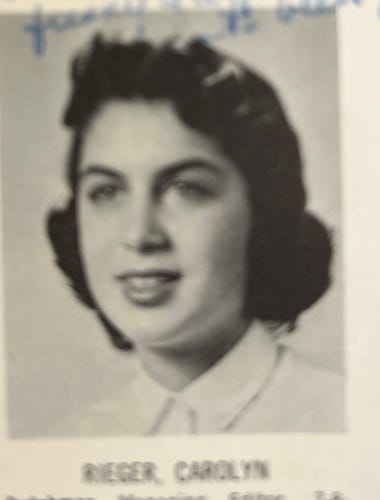
My rival for Larry’s affection was Carolyn Rieger, a fellow student but not one of my close friends. We both knew that Larry alternated dates with each of us and laughed about it with genuine good humor—even after he chose Carolyn as his date for the Junior Prom, the highlight event of that year. I was elected Senior Class Secretary for the Fall semester, and Carolyn got the job in Spring. We both wrote for the school newspaper, the Dutchman, and when senior year came around, Carolyn was appointed Managing Editor and I the lowly Copy Editor.
Looking at our yearbook photos today, Carolyn is lovely—long dark curly hair, shapely eyebrows, slim nose and curvaceous lips. I was not any of those things, rather pudgy actually.
“Wouldn’t it be funny if we marry twins?” Carolyn wrote in my yearbook. I surely wrote something similar in hers.
Even back then, private colleges were expensive, and both our families were decidedly middle-class and middle-income. Carolyn’s father, I later learned, was a public school teacher and mine earned a modest living as a lawyer. Both of us yearned to attend Cornell’s College of Arts and Sciences; minus a scholarship, however, it was beyond both of our parents’ means. There was another way, however: Cornell also housed several state-supported colleges. Accordingly, Carolyn was one of many Erasmus girls to apply to Cornell’s School of Home Economics.
But not me! Home economics? I wasn’t about to waste my college years cooking and learning child-rearing skills. Instead, I applied to another of Cornell’s state-financed schools, the School of Industrial and Labor Relations. Fresh from receiving an A+ on a term paper about John L. Lewis, the United Mine Workers leader, I decided (at age 16) I would train to be a labor negotiator, representing the oppressed union (of course).
Even before opening it, I knew what Cornell’s thin envelope portended. Yet the letter itself hit me hard. I wouldn’t be a mediator after all. I dropped all thoughts of that profession and resigned myself to a basic liberal arts education. That fall, I boarded the subway to Brooklyn College while Carolyn set off for Ithaca, beginning the life at Cornell I had dreamed might be mine.
For kids who didn’t attend an out-of-town college, the long Christmas break evoked mixed emotions; we were both happy to see our returning high school friends and envious of their good fortune. But Christmas of our junior year was different. The terrible news spread quickly. On the evening of Dec. 28, Carolyn Rieger, 19 years old, home from Cornell, was killed by a hit-and-run driver while crossing Park Ave on a first date with Gerald Silverberg, a medical student. He was seriously injured but survived.
A taxi driver pursued the perpetrator, forcing him to the curb. He was charged with leaving the scene, vehicular homicide and drunk driving, and released on $1000 bail.
I can see us teenagers before the funeral, moving from person to person, wordlessly holding each other tight; I can hear the sobs of Carolyn’s younger sister, who was my sister’s age, and her bereft parents and extended family.
I had never been an intimate friend of Carolyn’s. But after she died, I wended my way into her family’s orbit, sewing aprons in the kitchen with her mother and aunt to raise money for a scholarship in her name, as if stitching fabric could mend the enormous hole in their hearts or if my presence might soften the space Carolyn had filled. I worried that the opposite might be true, that I would remind them of her loss. We were so alike and I was standing in the life she should have kept living. We wouldn’t marry twins and she would never marry.
A few months after her death, the New York Times reported that a rare first edition of Henry Fielding's novel Joseph Andrews had been presented to the University by Carolyn’s three roommates as “a lasting memorial to Miss Rieger, who had studied Joseph Andrews as part of her course work at Cornell.”
Who knew a Home Economics student could take English literature courses at Cornell?
Carolyn’s date, Gerald Silverberg, today is emeritus professor of Neurosurgery at Stanford University and CEO of a company working to develop a treatment for Alzheimer’s. He is married and has three adult sons.
Once my yoga teacher suggested during Savasana (relaxation) that we all recite a three-sentence mantra: “I am the luckiest person I know. Luck is on my side. I am lucky.” Thinking of Carolyn, I was unable to say those words. The randomness of luck had dealt us different hands.
Six years later, I gave my firstborn the middle name Carolyn. Carolyn’s parents and an aunt sent gifts for the baby. I stayed in touch with her mother for many years, our connection being the love we both felt for Carolyn, our shared grief, and the remembrance that will live beyond our years. I’ve never forgotten her.
Very sad and interesting Barbara. You didn’t mention Barnard.
Thank you, Barbara, for this moving account.